Showing posts with label Mooney. Show all posts

Monday, August 19

The Battle of Georgian Bay


Report on the recent actions at Penetanguishine and Georgian Bay, off Lake Huron, in Upper Canada: 13 August, 1813

To Sir James Rehme, K.B. Captain, HMS Acasta, on the American Station, via Halifax.


Sir James:

     Herewith is my report as Senior of the Special Detachment from Acasta, assigned to H.M.A.T. Chatham, Captain Christopher Sorenson, commanding. 

     As my travels were delayed by necessary preparations, en route, I sent the detachment ahead to the Penetanguishene Station under the command of Mister Midshipman Linden. With him were Master’s Mate P. Mahone, Surgeon’s Mate J. Girard, Landsmen A. Weremeichik, N Weremeichik, and M Ledford, and Ship’s Boys A Girard and F Girard.

     Mister Linden reported to Captain Sorenson in the afternoon of Thursday, 8 August, at the site of Chatham’s encampment. Camp was speedily set, and the Acastas were exemplary in their efficiency and zeal, in helping to set the camp.  The evening was spent in preparation, in anticipation of expected action, the next day.  In the morning, a combined crew of Chathams, Acastas, and a Psyche or two, who had arrived as a “Vanguard” of sorts for their ship, set out to scout the harbour, and the adjacent inlet to the south. They, in company with the flotilla under the command of Commodore Hurlbut,  engaged a pair of American “Schuners” that had been sent to harry us.  After an effective, but inconclusive engagement, our boats broke off the engagement, leaving the Americans in place, as they would need repairs to follow, or continue the engagement. The afternoon saw our boats again engaged with the Americans, to the Americans’ advantage. It was only the next day, Suaturday, that we were able to secure the upper hand, when the Americans sent troops to try and capture HMS Tecumseth, nearing completion at the Penetanguishine shipyard. By the combined efforts of our flotilla and our land forces, we were able to force the Americans to retreat. 


    All of this, Mister Linden reported to me, upon my arrival, that evening. On Sunday, the Americans made a final, fruitless effort to take the harbour and shipyard, but they met with even less success, than previously. At last report, the Americans present struck their camp, and retreated back across the Niagara River, leaving the harbour once again secure. 

     I am pleased to report that all the Acastas present in our party  served their duty with great zeal, and little difficulty. Mister Linden had no qualms about exerting authority as needed, without resorting to excess. With the usual guidance and tutelage, I make no doubt he will become an officer of  perceptive ability, and will continue to bring honour to his crew, his ship, his service, and his King and Country. 

     The only dark note on the whole expedition, was that Master’s Mate Mahone shewed serious neglect to our navigational equipment, leaving it out to be dampened by the dew. No significant damage resulted, but I had rather stern words with Mahone, and, unless he shews better stewardship in future, it may be necessary to reconsider his appointment.

I sign myself 
Your Servant
Will’m Mooney
Sailing Master, H.M.S. Acasta,
On detached service to H.M.A.T. Chatham,
At Penentanguishine Harbour, Upper Canada


Shipmates: 

     The 1812 Grand Tactical at Discovery Harbor was a great success, from my perspective. It was
our first Grand Tactical, so we weren’t sure what to expect. We had intended to arrive Wednesday evening, but weren’t able to leave Maryland until then. We drove all night, and arrived on sight at about noon, Thursday. Signage was little help in figuring out where we were supposed to go, but somebody had posted that we needed to enter by the NORTH gate, and that was the clue that helped us find our way.  Once there, we located our camp, and reported in to Christopher Sorenson, and met those Chathams (and Psyches) present. Over the course of the day, the remainder of Acastas and Chathams arrived and set up. Weather was variable, rotating between drizzle, cloudiness, and open (hot) sunshine. Needless to say, we only got the comfortable cloudiness when we decided to take a break from setup. As soon as we went back to campwork,  the alternating sunburn and rain returned.  
     The Chathams were experiencing the usual trickiness associated with their first real gathering as a unit, but they soon figured it all out. They were gracious hosts, and it was a joy to work with them. I hope we will continue to host each other, as needed, at future events. 

     The events of the weekend run together, in my memory, so I hope you’ll all forgive me, if I jumble things up, or misspell or completely omit names.  I’m not even entirely sure who was Acasta, and who was Chatham!

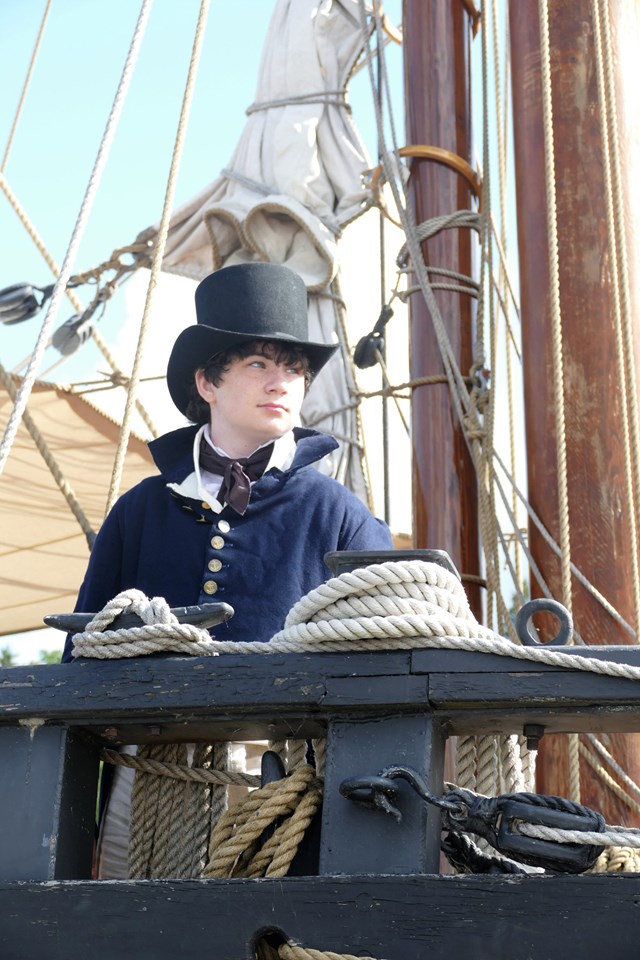
Sam Linden wore his coat the entire weekend, rain, shine, or drizzle, which only served to enhance his image as the eager young Officer-in-Training.

Tony and Berna Gerard brought their whole family, though once on site, we saw little of the boys, as they were off fighting their own war, with the other kids of the camp.  By Sunday morning, all the kids had pretty much formed their own Penentanguishine Militia, with a Captain, Serjeant, and semi-formed ranks.

     As I spent most of the weekend out fighting the Johnathans, I can’t say how the ladies spent their weekend, but I can say that there was ALMOST TOO much to do, for those of us “under arms”.  I got to tour H.M.S. Tecumseth, and we all sang below decks, and in the Tecumseth museum, there was a Twilight Zone moment, when I called Tony over, to point out a jackknife fleam, only to have Tony pull the EXACT SAME FLEAM from his pocket! He had recently bought his from eBay, and it was clearly made by the same maker, and definitely within a FEW MONTHS of the one in the display case! They even had chips missing from the horn scales, in the same place!

     There could have been a bit more effort beforehand, with regards to signage, camp assignments, etc., to make setup a bit more streamlined and effective,  A pile of street signs on the ground near Registration should have been placed by Wednesday, IMO, and a map showing camp assignments would have helped everyone get properly set, earlier. Perhaps, in future, each unit could be asked to submit a roster of tent space needed, with a nearby overflow area, for late additions. From this, an assignment map could be generated. 

     My other criticism, and my most significant one, is that there was a large area of picnic tables under marquis canopies, in the corner of the camp, with a modern stage, lights, and loudspeakers, with various bands playing in the afternoon and evening, almost to midnight. It very effectively broke the historical feel of the camp, especially when the bands were playing Dolly Parton or Bob Seger songs. However, even sea shanties over loudspeaker ruin the ambience. I hope that, in future, they decide to eliminate the live “entertainment” element, entirely. It put a HUGE damper on our own usual practice of singing, in camp. 

     In conclusion, the event was MOSTLY well-organized, and, except for trying to sleep to the nearby amplified strains of “That Old-Time Rock & Roll”, really enjoyable. I hope to visit the site again, soon, and to likewise attend another Grand Tactical.

     H.M.S. Acasta did well, and it was an honor and a joy to accompany Chatham on her “Maiden voyage”. I come away from this event, with one, inescapable conclusion:
H.M.S. Acasta needs a boat!   ;-)


Monday, March 18

The Art and Science of Knotwork: a Primer

By Buzz Mooney

When you mention the word “knotwork”, different people will picture different things: The rigging of sailing ships, 60s macramé wall hangings, or elaborate ancient Celtic graphics, seen in ancient Irish Gospels, like the Book of Kells.  It helps to sort through the confusion, by understanding that these are all, at their roots, the same thing: a form of continuous-line weaving. 

In my youth, as a Boy Scout, I struggled with knot-tying: A knot I had JUST learned, and tied successfully, was lost to me, minutes later. “The rabbit goes around the tree, and the shark jumps over it… no, the shark eats the boat, then the rabbit eats the shark… No…” Knot-tying was like Algebra: complicated, and hard to imagine how I’d use it, in real life. It wasn’t until my early 20s, when I developed a fascination for Ancient Celtic art, and knotwork, in particular, that I began to see the patterns and architecture of knots. And when I began my fascination with Sailing Ships, I began to see that knots are like old-style LEGO, or Tinkertoys: You only really have a few different pieces to work with: It’s how you COMBINE them, which makes all the different knots.  When I went to Hollywood, to work in Special Effects and Props, I took my newfound understanding of the Art of Ropework with me: When James Franco played James Dean, I did the fancywork shoulder-sling on his conga drum, and the “monkey’s fist” he plays with on the set of “Giant”. For Band of Brothers, I coiled all the letdown ropes the 101st guys wore for the Normandy jump. I even did the ropework for a prototype hammock for Master and Commander, but, alas, another Prophouse got the gig, so my work didn’t appear in the film. Having a working CONTEXT to use this knowledge, made all the difference.

I won’t go much into the TYPES of knots: Hitches, to secure a line to an object; Bends, to temporarily connect two lines, Splices, to PERMANENTLY connect two lines, or create a clean end on a line, and True Knots, to create a stop or other such feature. I’ll talk, primarily, of the STRUCTURE of knots.  In the accompanying images, I’ll be using red nylon rope: It’s easier to see the various elements of each knot, than with a natural-fiber, laid rope.

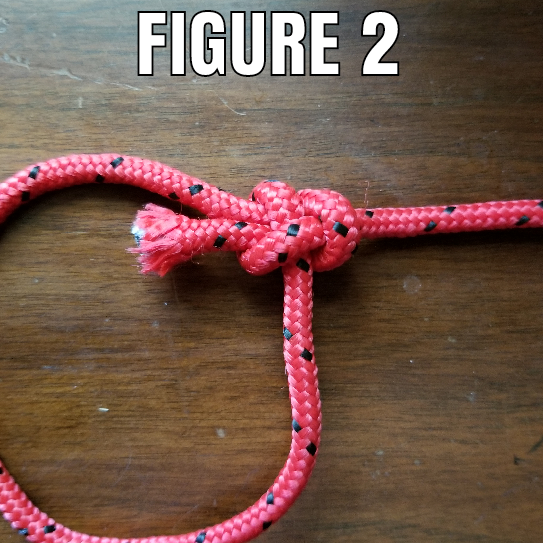
To understand what I mean about knots being made up of only a few, related elements, let’s look at the Sheet Bend (Figure 1): This is a quick, temporary hitch for connecting two lines.  You can see that one line is simply a loop, the other goes up through, around under both legs of the loop, and up and across, passing under itself. Now look at the Bowline (Figure 2): It’s EXACTLY THE SAME KNOT! The only difference, is that the working end of the line from the right, loops around to become the standing end of the line from the left.  So here, one of the most basic bends becomes one of the most basic hitches, simply by virtue of the loop. Cut the loop, and it’s a Sheet Bend.


Now, lets look at Two Half-hitches (Shown loose, in Figure 3, and taut, in Figure 4): If I slide it off the belaying pin, and snug it up (Figure 5), you can see the way is creates a diagonal, across itself, making a sort of “Letter N”.  If we look at the Clove Hitch, (Figure 6) you can see that same “Letter N” is formed around the pin, itself, instead of around the standing part of the line. If I KEEP “throwing” Hitches around the pin, I get “French Hitching” (figure 7); a decorative and protective covering, which can also improve handgrip on railings, etc. If, however, I ALTERNATE the direction of subsequent hitches, I get “Cockscombing” (Figure 8), which serves the same purpose, but with the resulting ridge running straight down one side, rather than spiraling. The Taut-line Hitch (Figure 9) many of us learned in Scouts, for adjusting tent ropes, is just another variation on the use of Half-Hitches.


To tie the infamous Sheep Shank (Figure 10), double the rope back on itself, twice, making an elongated “S” or “Z”, and throw a half-hitch over either end.


When you start getting into Stop-knots, like the Wall, the Crown, the Wall-and-Crown, or even the Matthew Walker, or Splices, or into Turk’s Heads, the principles of the aforementioned Celtic Art come in: In Knotwork, the Artist generally follows a rule of “Over one, under one” (or Over 2, under 2, etc.) In addition, on splices, and most good Stop-knots, you’ll be using the individual yarns of the line, untwisted from each other, to create your knot.  Here, I’ll be using three separate ropes, taped in a bundle, to represent the three individual yarns, unlaid from the end of the rope, to create a basic Crown Knot. First, laying open the yarns, I bring one up and over, down between the other two, laying it alongside the standing part of my rope (Figure 11). I then take the next end, and do the same (Figure 12 and 13). But I can’t simply bring the third yarn up and over the other two: it has to be interwoven with them, so that each holds its neighbor in place.  To do this, I’ll draw the first two loops tighter, to help me see where I need to go.  As you can see here, (Figure 14) yarn#1 isn’t holding anything down, and nothing is holding down yarn #2. So Yarn # 3 has to go OVER #2, and UNDER #1, like so: (Figure 15). When I draw them up tight, (Figure 16) you can see that they form a tight triangle, with each going over one, then under the next. If I continue this pattern, (Figure 17 and 18) I can build a larger knob, useful to stop a line running out of a block, or to form a handhold at the end of the line.


This is by no means an exhaustive exploration of knotwork, but, hopefully, it gives a basic understanding of the structure and architecture of ropework: The basic, geometric principles that help to create not just a knowledge of how to tie several knots, but how to UNDERSTAND how knots work, and to choose or develop the knots needed for any task.

Recommended reading:
The Arts of the Sailor. Hervey Garret Smith

The Marlinspike Sailor. Hervey Garret Smith

Celtic Art: The methods of its Construction. George Bain

Ashley Book of Knots.  Clifford W. Ashley

The Sea Scout Manual. Boy Scouts of America.
(I recommend looking into some of the earlier editions, since content changes over time. I also suggest seeing what the British Naval Brigade/National Sea Cadets may have published. Such guides tend to focus on the basics, and can be very helpful for “learning the ropes”, quite literally.)

Thursday, December 20

Finding (C.S.) Forester


Finding (C.S.) Forester:
sorting through the Hornblower canon.
By Buzz Mooney

   Readers of Napoleonic-Era Royal Navy fiction almost universally express a preference for Patrick O’Brian’s brilliant Aubrey-Maturin series over all other works in the genre, but if there is a first-runner-up,  it has to be C.S. Forester’s Horatio Hornblower.  Hornblower is actually a sentimental favorite of mine, because my father recommended it to me, and I finally started reading it when I found his few volumes, after he passed away. I find that I identify with Hornblower’s constant self-doubt, which compels him to pretend to be brave, in an effort to compensate for his misguided sense that he is a coward. The result, of course, is that Hornblower will stand where others will run. He will toil where others will quit, and he will persevere, where others would despair.  Hornblower is also the series that sparked my interest in the Royal Navy of this period. It was only after reading all the Hornblower I could find, and I was eager to find more about the subject, that I started reading O’Brian.

  Interested readers, however,  will find that reading Hornblower is not as easy as reading O’Brian, and not for stylistic reasons.   While O’Brian wrote his stories in narrative order, starting with MASTER AND COMMANDER in 1969, and ending with the incomplete novel posthumously published as “21”, in 2004, Forester did not follow any particular order.  Forester began with the novel THE HAPPY RETURN, set in 1808,  (Published in the US as BEAT TO QUARTERS) and ended with the HORNBLOWER AND THE CRISIS, set in 1805. The rest of the canon stretches from 1793 to 1848. This allowed Forester more flexibility in his time settings, avoiding such narrative quick-fixes as O’Brian’s several-year-long summer and fall of 1813, but resulting in some overlap among his stories; the short story Hornblower’s Charitable Offering occurs aboard the Sutherland, which Hornblower OTHERWISE commands only during  the novel A SHIP OF THE LINE.  Also, many of the books and stories were published under different titles in the UK and the US.

  The biggest difficulty in reading the entire Hornblower canon is simply FINDING all the stories. Some were published as novels, but some of the stories appeared first in magazines. No single publisher has published the entire canon, and it cannot be found in a tidy set, unlike O’Brian. The Hornblower aficionado  is almost compelled to seeking out electronic copies of some stories.  HORNBLOWER AND THE CRISIS sometimes includes Hornblower and the Big Decision/Hornblower and the Widow McCool, and  The Last Encounter, while The Hand of Destiny, Hornblower’s Charitable Offering, and Hornblower and His Majesty were only published in book form in 1976, in HORNBLOWER ONE MORE TIME, which can rarely be found for less than $800. However, those three stories and the two included with Crisis are available on line as THE HORNBLOWER ADDENDUM.

  Prospective readers may be somewhat put off by the complications I’ve mentioned, but they only apply for readers who want to read the ENTIRE canon: Most of the books are commonly available at libraries and bookstores. Perhaps, one day, we may even be able to convince a publisher to find a way to publish the entire canon, in a single series. Until then, here is a list of the Hornblower stories in approximate narrative order: Book titles are in bold caps, story titles are italicized. Approximate narrative dates and the ship to which Hornblower is assigned, are included.

MR. MIDSHIPMAN HORNBLOWER (Jan 1793 –Nov 1797): includes the following stories:
   Hornblower and the Even Chance (Justinian)
   Hornblower and the Cargo of Rice (Indefatigable)
   Hornblower and the Penalty of Failure (Indefatigable)
   Hornblower and the Man who Felt Queer (indefatigable)
   Hornblower and the Man Who Saw God  (Indefatigable)
   Hornblower, the Frogs, and the Lobsters (Indefatigable)
   Hornblower and the Spanish Galleys (Indefatigable)
   Hornblower  and the Examination for Lieutenant (Indefatigable)
   Hornblower and Noah’s Ark (Indefatigable)
   Hornblower, the Duchess, and the Devil (Indefatigable)
     -end MR MIDSHIPMAN HORNBLOWER-
The Hand of Destiny (1796, Frigate Marguerite)
Hornblower and the Big Decision (aka Hornblower and the Widow McCool  and Hornblower’s Temptation)  (1799, Renown)
LIEUTENANT HORNBLOWER (Spring 1800- March 1803, Renown)

HORNBLOWER AND THE HOTSPUR (March 1803-April 1805, Hotspur)
HORNBLOWER  AND THE CRISIS (HORNBLOWER DURING THE CRISIS) (April 1805-Fall 1805, Hotspur)
HORNBLOWER AND THE ATROPOS (Jan 1808 Atropos)
BEAT TO QUARTERS (aka THE HAPPY RETURN) (June 1808-Summer 1808, Lydia)
SHIP OF THE LINE (aka A SHIP OF THE LINE) (May 1810-Oct 1810, Sutherland)
Hornblower’s Charitable Offering (1810, sometime during the narrative period of SHIP OF THE LINE, Sutherand)
FLYING COLORS (Nov 1810-Fall 1811, escaping captivity, through France)
Hornblower and His Majesty (1812, Royal Yacht Augusta)
COMMODORE HORNBLOWER (April 1812-Dec 1812, Nonsuch)
LORD HORNBLOWER (Oct 1813-June 1815, Porta Coeli)
ADMIRAL HORNBLOWER IN THE WEST INDIES (May 1821-Oct 1823, Crab)
The Last Encounter (1848, Hornblower’s estate at Smallbridge)

Tuesday, September 18

New Toys


Today's post and image submitted by Buzz Mooney

Clockwise, from upper left: wooden parallel rule with nickel-plated arms and no markings; brass protractor; Icelandic Spar, believed to be the sunstone, used by Vikings; and a brass chart glass, for reading fine details on charts.

The sunstone, as a navigational device, is not documented to our period (1800-1810), although a spar crystal WAS recovered from the sunken wreck of the Alderney, sunk in 1592. It was found near navigational equipment, suggesting that it may have been used for that purpose. its properties WERE known, and studied, during our period, so I bought one as a navigational/scientific curiosity. I intend to "mount" it in a hanging Turk's Head, as I also plan to do with my lodestone (primitive compass): a piece of magnetic hematite. These primitive stones will only be included in my kit, for events in which I present the earlier history of navigation.